admin
admin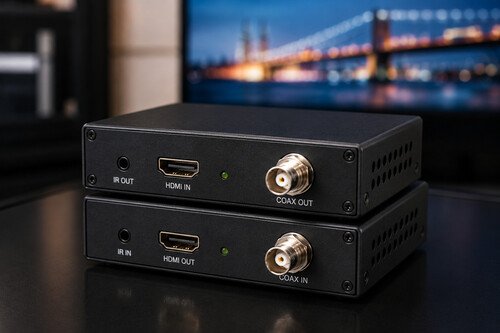
In many audio-video installations, the distance between an HDMI source and a display can be a serious limitation. Standard HDMI cables are convenient for short connections, but they are not always practical when a signal must be sent across a room, between floors, or through an existing building infrastructure. HDMI over COAX technology solves this problem by allowing HDMI video and audio signals to travel through coaxial cable. HDMI over COAX systems typically use a transmitter and receiver. The transmitter converts the HDMI signal into a form suitable for coaxial transmission, while the receiver converts it back into HDMI near the display. This makes it possible to connect media players, computers, cameras, receivers, or video systems to televisions, monitors, and projectors over longer distances. This article explains what HDMI over COAX is, how it works, where it is used, and why it can be a practical solution in homes, offices, hotels, schools, retail spaces, security systems, and commercial AV installations. It also discusses its main advantages, limitations, and key factors to consider before choosing this type of HDMI extension.
What Is HDMI over COAX?
HDMI over COAX is a video transmission solution that allows HDMI audio and video signals to be sent through coaxial cable instead of a standard HDMI cable. It is used when a video source needs to be connected to a display over a longer distance, or when an existing coaxial cable infrastructure is already available in a building.
HDMI is widely used for modern digital video and audio connections. It can carry high-definition picture and sound through a single cable, making it common in home entertainment, commercial AV systems, digital signage, security monitoring, education, and presentation environments. However, HDMI cables are mainly designed for relatively short direct connections. When the distance between the source and display becomes too long, the signal may become unstable or fail completely.
Coaxial cable, often called coax, has been used for decades in television, satellite, cable TV, and RF distribution systems. It is durable, widely installed, and capable of carrying signals over longer distances than a normal HDMI cable. HDMI over COAX technology makes use of this cable type to extend, convert, or distribute HDMI-based content in situations where standard HDMI wiring is not practical.
Understanding the Basic Concept
The basic idea behind HDMI over COAX is simple: an HDMI signal is converted into a form that can travel through coaxial cable, then converted back into HDMI at the receiving end.
A typical system includes two main devices. The first device is a transmitter. It connects to the HDMI source, such as a media player, computer, camera system, set-top box, game console, video switcher, or digital signage player. The transmitter processes the HDMI signal and sends it through a coaxial cable.
The second device is a receiver. It is placed near the display, projector, monitor, or television. The receiver accepts the signal from the coaxial cable and converts it back into HDMI so the display can show the image and play the sound.
This setup allows an HDMI source and an HDMI display to be connected even when they are far apart. It is especially useful in buildings where coaxial cables are already installed and running new HDMI or network cables would be expensive or inconvenient.
Why Use Coaxial Cable for HDMI?
Coaxial cable has several practical advantages. First, it can support longer cable runs than typical HDMI cables. Standard HDMI cables are convenient for short distances, but they can become unreliable over longer runs unless special active cables, boosters, or extenders are used.
Second, coaxial cable is often already present in many buildings. Homes, hotels, offices, schools, hospitals, apartment blocks, and commercial facilities may already have coaxial wiring in walls, ceilings, equipment rooms, and distribution panels. HDMI over COAX equipment can reuse this existing infrastructure.
Third, coaxial cable is mechanically strong and well shielded. It is designed to reduce interference and maintain signal integrity. This makes it suitable for professional installations where stable video transmission is important.
Finally, coaxial cable is familiar to many installers. It is commonly used with splitters, connectors, patch panels, and distribution equipment. In some projects, using coax can reduce installation time and avoid major renovation work.
HDMI over COAX vs. HDMI RF Modulation
HDMI over COAX can refer to different technical approaches, so it is important to understand the distinction between HDMI extension over coax and HDMI RF modulation.
In a direct HDMI over COAX extender system, the goal is usually to send one HDMI signal from a source to one display. A transmitter and receiver work as a pair. The display receives the signal through its HDMI input after the receiver converts it back from coax.
In HDMI RF modulation, the HDMI signal is converted into a television channel and distributed over coaxial cable as an RF signal. Televisions receive the content through their built-in tuners, not through HDMI inputs. This is useful when one source needs to be distributed to many TVs as a channel.
Both solutions use coaxial cable, but they serve different purposes. HDMI over COAX extenders are usually best for point-to-point HDMI extension. HDMI RF modulators are better for channel-based distribution to multiple televisions.
How HDMI over COAX Works
The operation of HDMI over COAX depends on the technology used by the equipment, but the general process is similar.
First, the HDMI source sends digital video and audio into the transmitter. This signal may include high-definition video, embedded audio, and sometimes control data. The transmitter converts the HDMI signal into a format suitable for coaxial transmission.
The converted signal then travels through the coaxial cable. Depending on the system, one or more coaxial cables may be required. Some solutions use a single coaxial cable, while others may use multiple cables for higher bandwidth or different signal types.
At the receiving end, the receiver reconstructs the HDMI signal. It outputs standard HDMI to the display. From the user’s point of view, the system works much like a long HDMI cable, even though the middle section uses coaxial cable.
Some systems may also support additional features, such as infrared control, audio extraction, loop outputs, or signal equalization. These features can make the system more flexible in professional installations.
Common Applications
HDMI over COAX is used in many environments where HDMI signals need to travel farther than normal cable limits.
In homes, it can be used to connect a central media device to a TV in another room. For example, a media player or receiver located in an equipment cabinet can be connected to a display through coaxial cable that already exists in the wall.
In commercial buildings, HDMI over COAX can support meeting rooms, reception displays, lobby screens, training rooms, and digital signage. A source device can be placed in a secure equipment area while the display is installed in a public location.
Hotels and hospitality facilities may use coaxial infrastructure to send content to displays in conference rooms, bars, lounges, or information areas. Schools and universities can use HDMI over COAX to connect classroom displays, projectors, lecture capture systems, or campus information screens.
Security and surveillance systems can also benefit from this technology. A video recorder, monitoring station, or camera source with HDMI output can be extended to a control room display or remote monitor using coaxial cabling.
Use in Digital Signage
Digital signage is one of the most common commercial uses of HDMI over COAX. Digital signage systems often require screens to be installed far from the media player or control equipment. Running long HDMI cables may not be practical, especially in large buildings, shopping areas, transport facilities, or corporate spaces.
With HDMI over COAX, the media source can remain in a central location while the screen is installed where it is needed. This can simplify maintenance because the player or controller is easier to access.
In some cases, HDMI over COAX can also reduce equipment clutter near the screen. Instead of placing a media player behind each display, a source can be connected remotely and extended over existing cabling.
Video Quality and Resolution
The supported video quality depends on the HDMI over COAX equipment. Many systems support high-definition video, such as 720p or 1080p. Some advanced systems may support higher resolutions, but this depends on bandwidth, cable quality, and the design of the transmitter and receiver.
Resolution is not the only factor. Frame rate, color depth, compression, and audio format may also affect compatibility. Some systems transmit video with very little processing, while others use compression to make the signal easier to send over coaxial cable.
In most everyday applications, HDMI over COAX can provide a clear and stable picture if the equipment and cable are properly matched. However, the final result depends on the full signal chain: the source, transmitter, coaxial cable, connectors, receiver, and display.
Cable Quality and Distance
Cable quality is one of the most important factors in HDMI over COAX performance. Not all coaxial cables are the same. Cable type, shielding, conductor quality, connector condition, and installation method can all affect the signal.
Long cable runs may cause signal loss. Poor connectors or damaged cable can create instability, dropouts, sparkles, or complete signal failure. Splitters, wall plates, and old cabling may also reduce performance if they are not suitable for the system.
For best results, the coaxial cable should be in good condition and properly terminated. Installers should avoid sharp bends, loose connectors, and unnecessary adapters. In professional installations, cable testing may be useful before final setup.
The maximum distance depends on the equipment and cable type. Some systems may work over moderate distances, while others are designed for much longer runs. It is important to check the technical limits of the system before installation.
Audio Support
HDMI carries both video and audio, and HDMI over COAX systems usually transmit audio together with the picture. This allows the display to receive sound through the HDMI output from the receiver.
Common audio formats may be supported, but compatibility depends on the equipment. In simple installations, stereo audio may be enough. In home cinema or professional AV systems, support for more advanced audio formats may be required.
Some HDMI over COAX devices may also include separate audio outputs. This can be useful when audio needs to be sent to an amplifier, speaker system, mixer, or recording device.
Control and Remote Operation
Some HDMI over COAX systems support remote control features. For example, infrared pass-through may allow a remote control signal to travel from the display location back to the source device. This means a user can control a media player or receiver even if it is located in another room.
This feature is useful in home entertainment systems, conference rooms, classrooms, and commercial installations. It allows the source equipment to remain hidden or protected while still being easy to operate.
Not all HDMI over COAX systems include control features, so this should be checked when planning an installation.
Advantages of HDMI over COAX
One of the biggest advantages of HDMI over COAX is the ability to extend HDMI signals over longer distances. This solves a common problem in AV installations where the source and display are not close together.
Another major advantage is the reuse of existing coaxial cabling. This can save time and reduce installation costs. In many buildings, coaxial cable is already installed in walls, ceilings, and equipment rooms. Using it can avoid the need for major rewiring.
HDMI over COAX can also improve system organization. Source devices can be kept in a central location, making them easier to manage, protect, and maintain. Displays can then be placed where they are most useful.
The technology is also practical in retrofit projects. Older buildings may not have modern AV cabling, but they often have coaxial infrastructure. HDMI over COAX provides a way to modernize video distribution without replacing all wiring.
Limitations and Challenges
Although HDMI over COAX is useful, it has limitations. The first limitation is compatibility. The transmitter and receiver must be designed to work together. A receiver from one system may not work with a different transmitter unless they use the same signal method.
Another limitation is that HDMI over COAX is often point-to-point. It may not work through standard TV splitters unless the system is designed for that purpose. If the goal is to distribute one HDMI source to many televisions, an RF modulation system may be more appropriate.
Cable condition can also be a challenge. Existing coaxial wiring may be old, damaged, poorly connected, or routed through unknown splitters. This can reduce performance.
Some systems may introduce latency if they use compression or processing. For movies, signage, presentations, and general viewing, this is usually not a problem. For gaming, live production, or interactive applications, latency should be considered.
Copy protection can also affect certain HDMI sources. Some protected content may not work correctly through conversion or extension equipment, depending on the system and usage rights.
Installation Considerations
Before installing HDMI over COAX, the first step is to identify the purpose of the system. If the goal is to connect one source to one display, an extender system may be suitable. If the goal is to distribute a channel to many televisions, an RF modulator may be the better choice.
Next, the cable path should be checked. The coaxial cable should be continuous, in good condition, and compatible with the required distance. Any splitters, amplifiers, or wall plates in the path should be evaluated.
The required resolution and audio format should also be confirmed. The system must support the output format of the source and the input capabilities of the display.
Power requirements are another practical detail. Both transmitter and receiver usually require power. Their placement should allow safe and reliable power connection.
Finally, the system should be tested before permanent installation. This helps confirm picture stability, audio performance, control functions, and overall compatibility.
HDMI over COAX Compared with Other Extension Methods
HDMI can also be extended using network cable, fiber optic cable, wireless systems, or IP-based video distribution. Each method has advantages.
Network cable extenders are common and can be convenient in modern buildings with structured cabling. Fiber optic systems support very long distances and strong resistance to interference. Wireless systems reduce cabling but may be affected by signal conditions. IP-based video systems offer routing flexibility and scalability.
HDMI over COAX is especially useful when coaxial cable already exists or when coax is preferred for durability and distance. It is not always the best option for every installation, but it can be highly practical in the right environment.
HDMI over COAX is a practical solution for sending HDMI video and audio signals through coaxial cable. It allows modern HDMI sources to be connected to displays over longer distances and can make use of existing coaxial infrastructure in homes, businesses, schools, hotels, healthcare facilities, and commercial AV systems.
The technology is useful for point-to-point HDMI extension, digital signage, presentation systems, security monitoring, and retrofit installations. It helps reduce the need for long HDMI cables and can simplify installations where coaxial wiring is already available.
At the same time, successful use depends on proper equipment selection, cable quality, distance limits, resolution support, audio compatibility, and installation planning. HDMI over COAX is not the same as HDMI RF modulation, and choosing the correct solution depends on whether the goal is direct HDMI extension or channel-based TV distribution.
When properly matched to the application, HDMI over COAX provides a reliable bridge between modern HDMI equipment and traditional coaxial cabling, making it a valuable option in many residential and professional video systems.